
Where leads slip away
Where towing calls slip away
Work out what missed calls cost you, with your own numbers.
Calls while you’re hooking up
You’re chaining a car out of a ditch or driving with a load on. A stranded driver who gets voicemail doesn’t leave a message. They call the next tow company on the map, and the one after that.
Living on motor club and dispatch calls
Club and dispatch work keeps the trucks moving, but the rate is theirs and so is the customer. Every direct call from your own website and Google profile is a job you price yourself.
“How much to tow my car?”
Price shoppers call three companies and go with the first clear answer. If nobody explains how you price (hook-up, miles, winching, after hours), you sound like the expensive one, or you never get the chance to explain.
Slide-off days
The first real snow puts cars in the ditch on I-90, Highway 95 and every hill in town, all in the same few hours. Every truck is out, the phone keeps ringing, and drivers who can’t get through keep dialing until someone else picks up.
“I don’t know where I am”
A driver from out of town on a dark stretch of highway can’t tell you the exit or the mile marker. Ten minutes on the phone, or a truck sent to the wrong spot, costs you the job and the review.
Getting paid on the shoulder
A cold, rattled customer wants to know what it costs and how to pay. Fumbling with a card reader in the snow, or arguing over a bill later, is a bad end to the call. A clear price and a payment link by text settle it before you unhook.
Police calls you don’t control
Law enforcement calls depend on lists and decisions that aren’t yours. Private calls from drivers, shops and property managers are the work you can grow, and they start with being easy to find.
Reviews from someone’s worst day
People call a tow truck when something has gone wrong. Grateful customers forget to say so, and the upset ones write the review. Without an ask once they’re home safe, your profile shows only the hard days.
Commercial accounts left on the table
Repair shops, dealerships, property managers and fleets need cars moved every week. If nobody follows up after the first job, or they can’t reach you when they need a truck, they call the company that answers.
Before they call
What drivers, shops and property managers check before choosing you
- Whether you can come now, and roughly how long it will take.
- What it will cost, or at least how you price: hook-up, miles, winching, after hours.
- Whether you can handle their vehicle: a car on a flatbed, a lifted truck, a motorcycle or an RV.
- Whether you take cards, and work with their roadside plan or insurance, if you do.
- Recent reviews that mention a fast arrival and careful handling.
How it works for towing companies
One system, from the first search to the next visit
Follow one driver through it, step by step. The Growth System page explains each step in full.
Step 1 of 8 · Get found
Show up when someone is stuck
Stranded drivers search and call the first company on the map that looks open. A complete Google Business Profile with your hours, trucks and service area helps you earn a place there. Pick your town and watch the example climb.
Your Business: not in the top 3 (position 9)
- Right main category
- Services listed
- Matching name and phone
- Steady new reviews
- Fast, clear website
- A page for your town
Illustration only. Real rankings depend on distance, relevance and prominence, and no one can promise a position.
Step 2 of 8 · Never miss a lead
Answer while you’re hooking up
The voice assistant answers, asks what happened and where they are, flags accidents and drivers stuck on the highway to you, and takes the details for the rest. Calls you miss get a text back in seconds.
Example call, shown as captions. Your assistant answers in a natural voice with your services, hours and prices, and transfers to you whenever a caller asks or it should.
Step 3 of 8 · One inbox
Locations, photos and every message in one place
Drivers text their location and a photo of the car. Shop requests, texts and website messages land in one inbox, so your driver knows where to go and what to bring.
Every channel, one inbox. Tap a conversation to answer it.
Example customers and messages. We connect your real channels and set up quick replies in your words.
Step 4 of 8 · Quote and book
A price they can approve from the shoulder
Send the quote by text, with the hook-up, the miles and any winching listed. They approve it on their phone, and the tow goes on the board for the next free truck.
- Estimate texted
- Customer opened it
- Signed
- Deposit paid
- Job added to your calendar
- Receipt and reminder sent
Example estimate. We set up your estimates, e-signatures and payments so customers can say yes from their phone.
Step 5 of 8 · Track every tow
Every call and tow on one board
From call to pickup to drop-off to payment, each tow moves along a board, with “truck on the way” texts and payment links sent for you.
Example jobs and amounts. Tap any card to move it along. We set up your stages and what happens at each one.
Step 6 of 8 · Reviews and referrals
Ask once they’re home safe
After the car is dropped, the driver gets a text with a link straight to your Google review box, and your number to save for next time.
Example customers and reviews. We set up the request text, the timing and your review link; the reviews are your customers’ own.
- Link shared
- Friend booked
- Job done
- Rewards sent to both
11 jobs from referrals
Example customers. You choose the reward; links are tracked automatically and rewards go out when the friend’s job is done.
Step 7 of 8 · Bring them back
Shops, dealers and property managers
Check-ins for the shops, dealerships, property managers and fleets you tow for, and a note to accounts that have gone quiet.
1 of 6 sent automatically. You did the work; the system did the remembering.
Example messages and timing. We set yours up around how your business actually runs.
Example customers and replies. We send only to customers who agreed to hear from you, and every text has an easy opt-out.
Step 8 of 8 · See what’s working
Know where your direct calls come from
A plain report on the 1st: calls, tows, account work, reviews and where each came from.
Example calls. We set up a number for each ad, sign and listing, record where every call came from, and show it in your monthly report.
What we set up
Set up and run for you
- A text back to every missed call that asks for the exact location
- Accidents and drivers stuck on the highway flagged to you at once
- “Truck on the way” texts with an arrival time
- A payment link by text, and a review request once the car is dropped
- Follow-ups for shops, dealerships, property managers and fleets
Tap any piece to see what it does and how it connects. See all our services
An illustration with a made-up business. Real results depend on your market.
Keep the calls coming
Where does repeat work come from for a towing company?
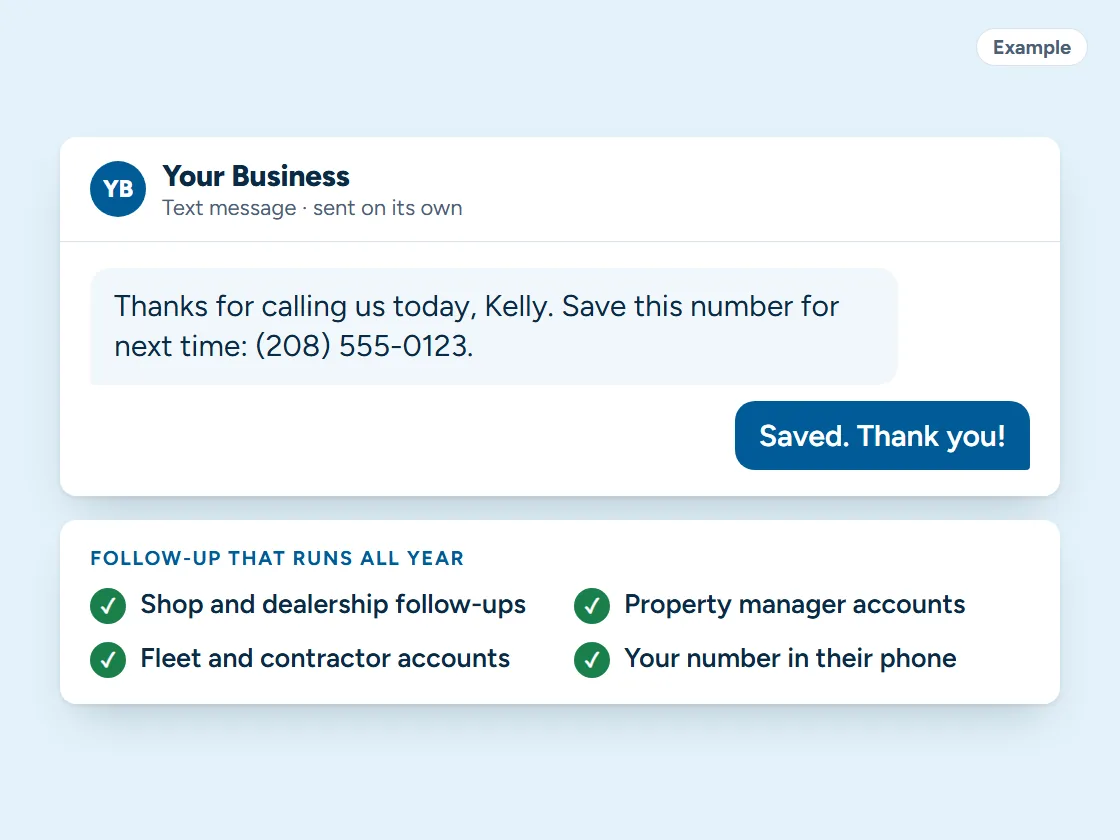
From shops, dealerships, property managers and fleets, and from drivers who keep your number, since most drivers hope they never need a tow again. We set up the follow-up that keeps you their first call:
- Shop and dealership follow-ups. After the first tow, repair shops and dealerships get a thank-you and a direct line, so the next car they need moved comes to you.
- Property manager accounts. Apartments, HOAs and businesses that need cars moved off their lots get one number to call and a record of every request.
- Fleet and contractor accounts. Contractors, delivery companies and fleets get a direct line and invoices by text, so a broken-down work truck goes to you first.
- Your number in their phone. After the tow, the driver gets your number as a contact to save, so the next dead battery or lockout calls you instead of a search.
Local search
How does a towing company get the call when someone is stuck?
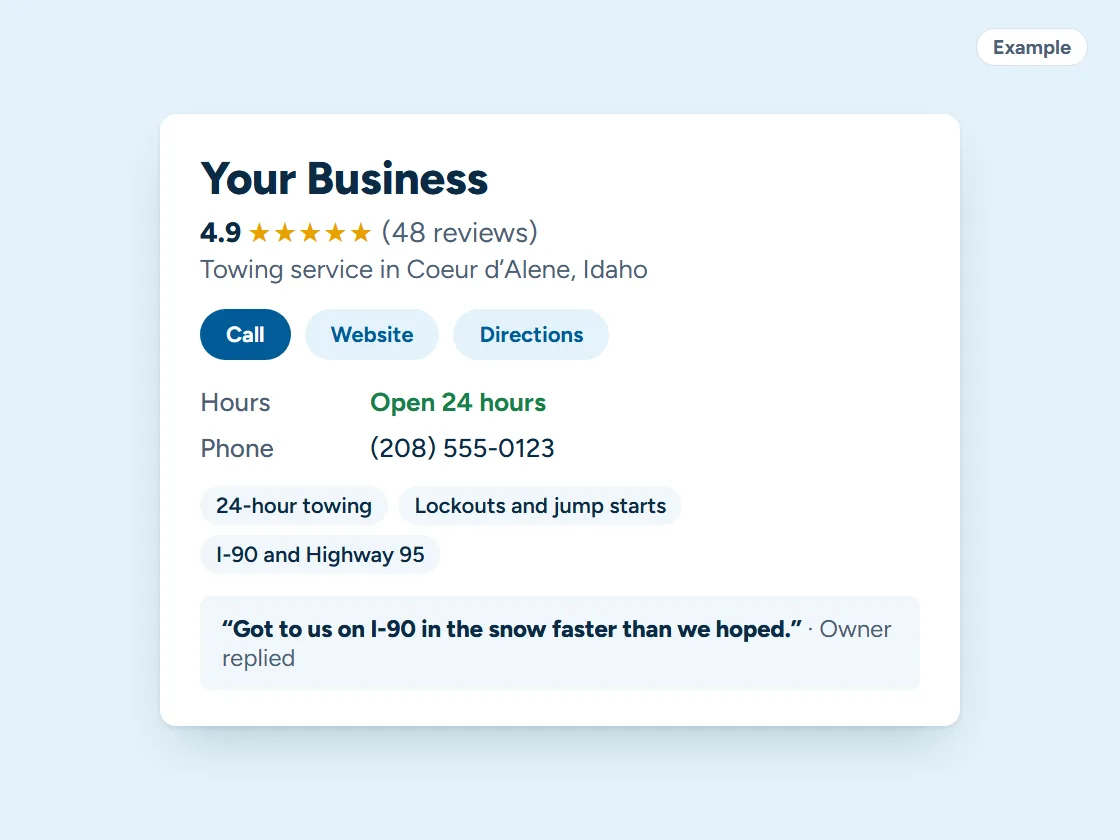
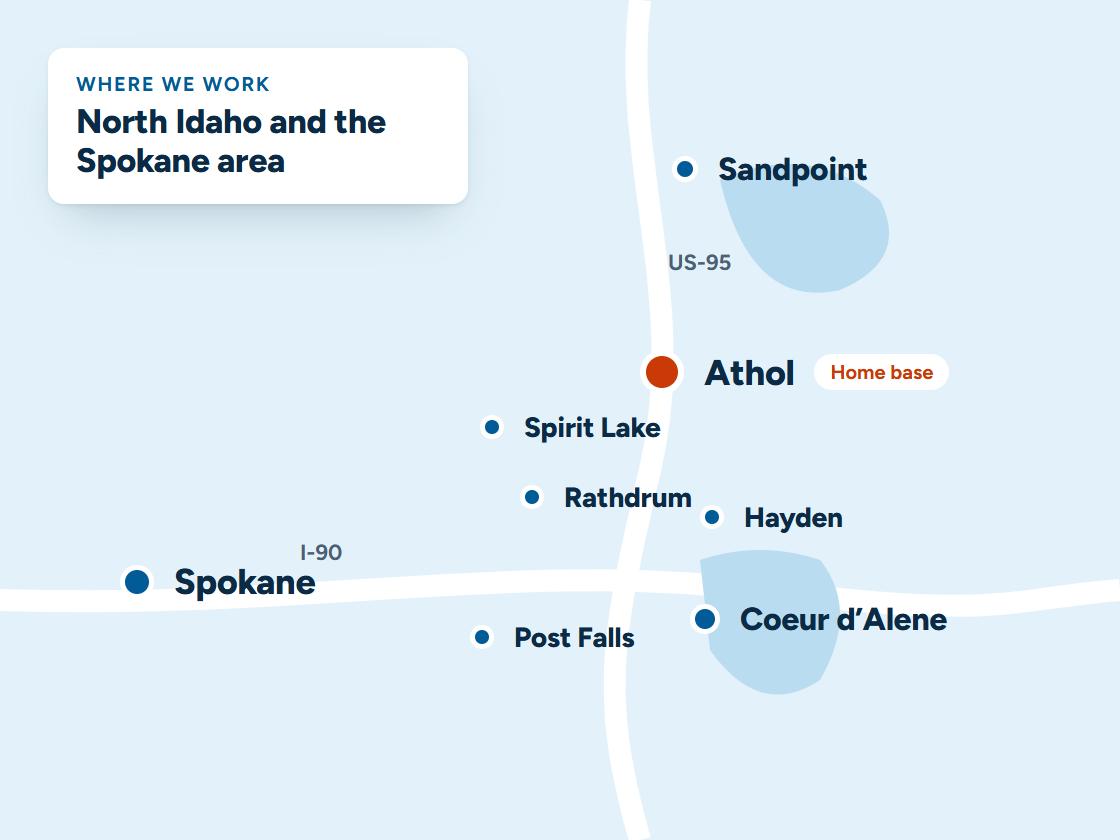
By looking open on the map: someone stuck on the shoulder searches “towing near me” and calls the first company that looks open. We keep your Google Business Profile complete, with your real hours, your service area and photos of your trucks. We build pages for towing, lockouts, jump starts, winch-outs, accident tows and private property tows, so you have a real shot at the top of the map in Coeur d’Alene, Post Falls, Hayden, Rathdrum, Sandpoint and Spokane.
More on local SEO and Google Business Profile management.

Your website
What a website for towing companies needs
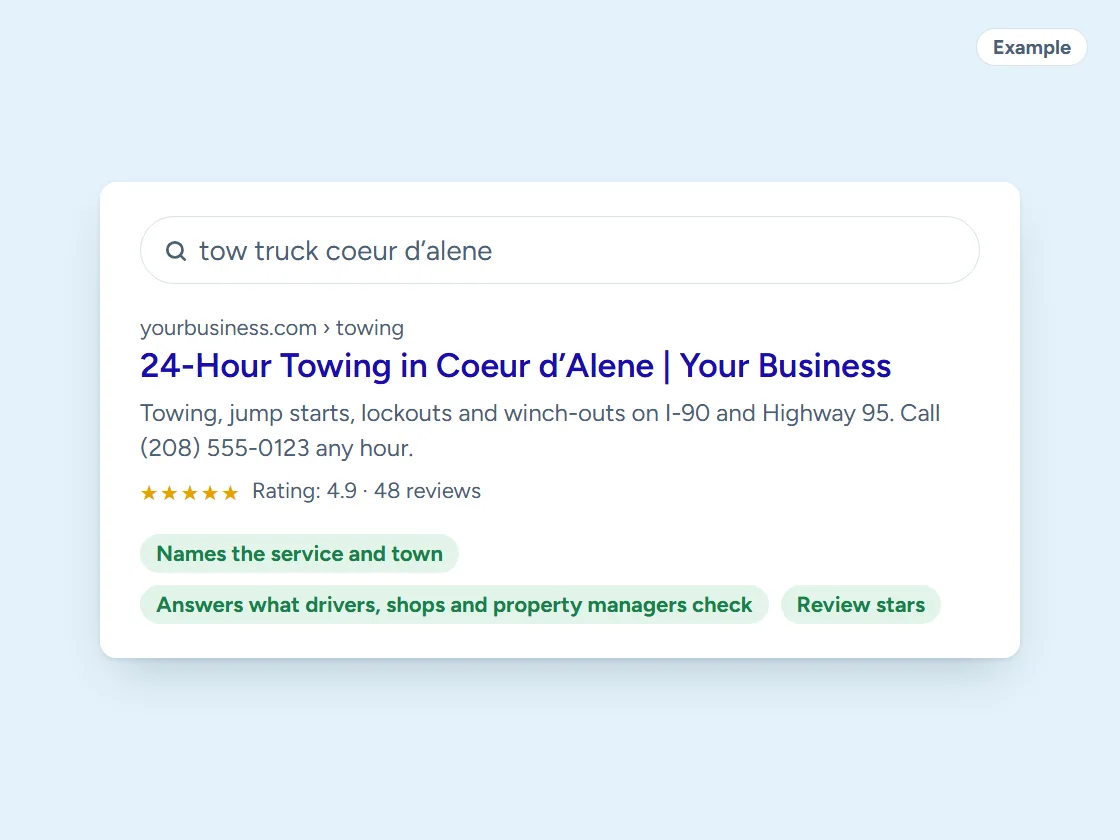
- A tap-to-call number and your hours at the top of every page.
- Pages for towing, lockouts, jump starts, tire changes, winch-outs, accident tows and private property tows.
- How you price, in plain words, and the ways people can pay.
- Your trucks and what each can haul, with real photos.
- Your service area and the highways you cover, matching your Google Business Profile.
Through the year
When are towing companies busiest in North Idaho?
In winter, with a second run of calls in summer. The first snow puts cars in the ditch on I-90, Highway 95 and every hill in town, and cold mornings bring dead batteries and frozen locks. Summer brings lake and camping traffic, overheated engines, RVs and boat trailers, and a steady run of breakdowns and accidents on the highways.
The shoulder is the riskiest place you work. Under Idaho Code 49-624, drivers must slow down for a stopped tow truck with its lights flashing, and change lanes where they can. A phone system that answers, asks for the location and sends the details by text keeps your drivers off the phone and on the job.
Questions
Questions from towing companies
What should a driver do while they wait on the highway?
If it isn’t safe to get out, stay in the car with the seat belt on and the hazards on. If anyone is hurt or in danger, call 911 first. In a winter storm, Ready.gov says to stay inside your car if you are trapped. The text back can say this while it confirms the tow.
Can callers send their location by text?
Yes. The text back asks them to share their location from their phone, or give the nearest exit, mile marker or cross street. It lands with the call, so your driver knows where to go.
Do lockouts and jump starts need their own pages?
Yes, if you want those calls. A locked-out or dead-battery driver searches for exactly that. Each page says what you do, how you price it and how fast you can come. If a child or a pet is locked in a car, the page tells people to call 911 first.
Should a towing website show prices?
A hook-up fee and how you charge for miles, winching and after hours help. Price shoppers call the company that gives a straight answer.
How do I get more direct calls?
Be easy to find and easy to reach: a complete Google profile, a page for each service, fast answers day and night, and fresh reviews. That is the work this system does.
What does it cost?
Plans start at $297 a month. The cards below show what each one includes, and every price is on our pricing page.

Pricing
Ready to get started?
Buy online in a few minutes with secure card checkout. Questions first? Call or text (208) 210-GROW or book a 15-minute call.
Starter website plan
$297/month + $697 one-time setup
Month to month. Cancel anytime.
- Up to 5 pages, built in about 2 weeks
- Hosting, security, updates and backups
- Google Business Profile set up and linked
- Speed work included
- Monthly report: visits, calls and leads
Most popular
Business website plan
$497/month + $997 one-time setup
Month to month. Cancel anytime.
- Everything in Starter
- Unlimited pages and content changes
- Missed calls get an instant text back
- Review requests after every job
- Calls, texts and forms in one inbox
Professional website plan
$997/month + $1,897 one-time setup
Month to month. Cancel anytime.
- Everything in Business
- Local SEO for each town you serve
- Weekly Google Business Profile posts
- Monthly ranking report
- Monthly strategy call
Keep exploring
Related
More trades
Want this running for your business?
Book a free 15-minute call. We’ll look at how calls and leads reach you today and show you what we’d set up.